
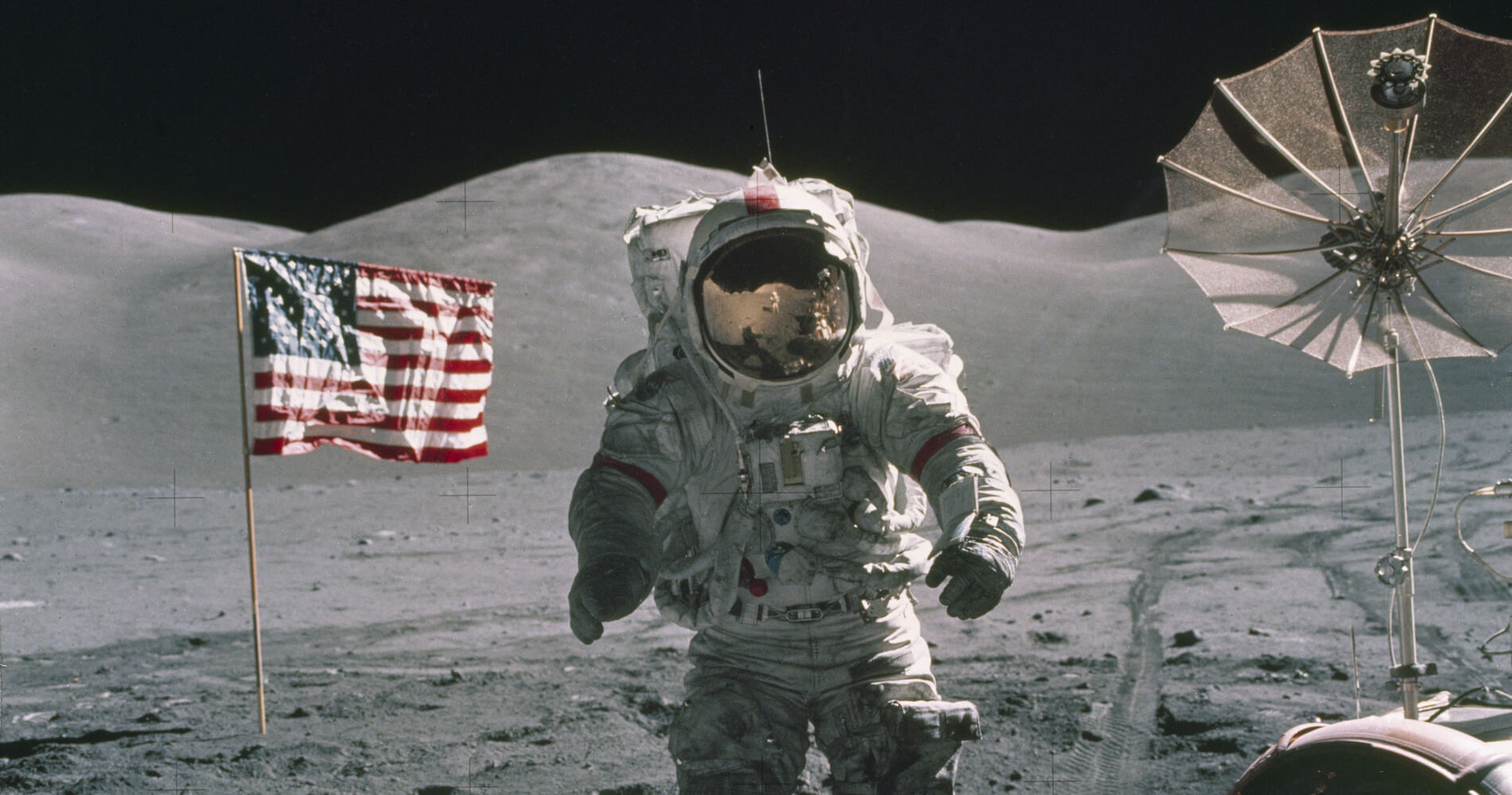
Today I’m going to analyze the Apollo Program budget. We’ll answer: how much did the Apollo Program cost? I’ll also review the return on that investment in space exploration.
Were the Moon Missions really a worthwhile endeavor?
Did sending a man to the moon accomplish anything more than create celebrity in the dark Cold War times?
Apollo Program Cost
The idea of returning to the moon has gained great interest in recent times. NASA indicated that it intends to re-explore our closest space neighbor.
America is working hard to lower the cost to return to space with SpaceX recently sending the first two astronauts to the ISS since 2011 aboard hardware made in the USA.
→ How Much Does It Cost to Go to Space? $6.25 Billion in 2020.
It seems that this has also created quite a bit of interest in our original moon exploration.
Let’s take a look at the hard numbers to see how the cost of going to the moon compares to the cost of other projects. Then I’ll tackle the subjective question of what gains can be attributed to going to the moon.
But first up, how much did the Apollo Program cost?
The Apollo Program cost roughly $25.4 billion, unadjusted.
What’s the cost of Apollo Program in 2020 dollars? $194 billion.
That’s our total cost to go to the moon.
Consider, however, that this was for a project spanning from 1959 to beyond 1970 with six successful missions.
Eventually, Apollo 11 landed humans on the moon.
Consider that some 409,000 laborers were employed by the lunar program. These jobs were either directly through NASA, outside university research, or contracted workers.
Total US Federal Outlays vs. Apollo Program (1959-1972)
How does the total Apollo Program cost compare to the U.S. budget in the mission’s years?

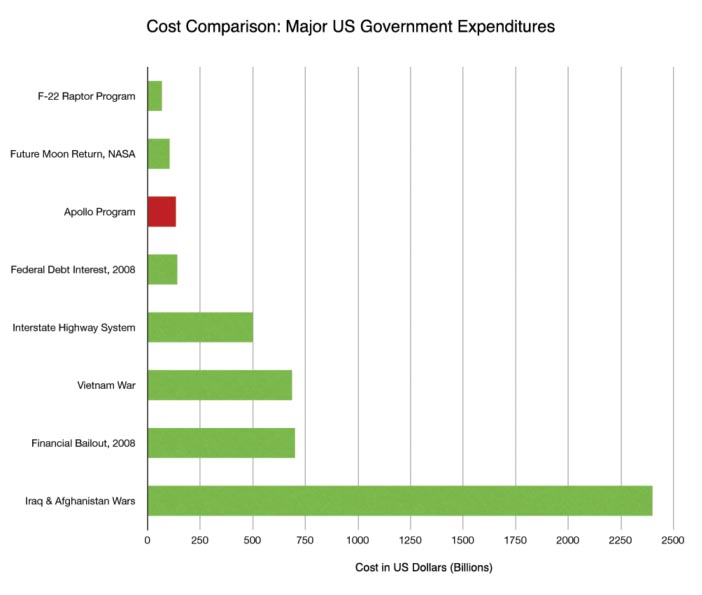
Let’s also look at the Apollo Program cost compared to other major government expenditures in U.S. history.
This data is adjusted for inflation to 2008 U.S. dollars.
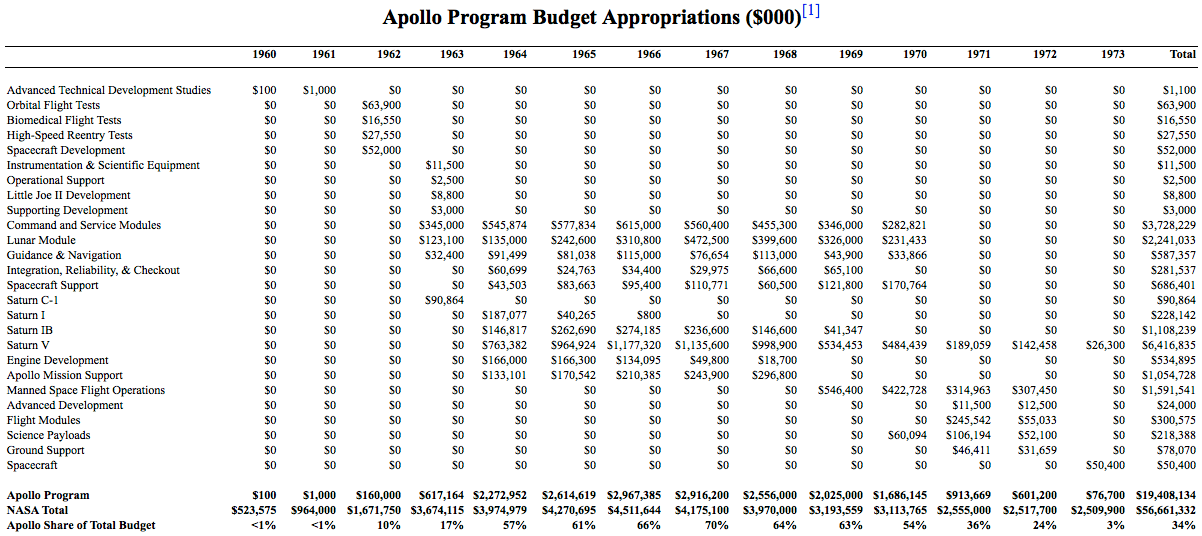
NASA Apollo Program Budget
NASA’s official budget appropriations for the entire organization from 1960 to 1973, including work after the final Apollo mission, was $56.6 billion.
That means the Apollo Program budget represented 34% of NASA’s spending, $19.4 billion.
The total Apollo Program budget appropriations from NASA don’t quite match the calculated total Apollo Program cost already mentioned from official depositions ($25.4 billion). This is most likely because of other funding sources and cost overruns.
Adjusted for inflation to 2008, NASA’s entire budget for this period was about $363 billion.
Some of the work for Apollo began in 1959. The last Apollo mission flew in 1972. NASA provides data for 1960-1973 to represent Apollo as these were the years that had Budget Appropriations specific to Apollo.
The US annual federal outlays (the amount of money the country spends per year, which is typically more than our budget) from 1959 to 1972 totaled $1.9 trillion US dollars. Converting these outlays from each of their years to an inflation-adjusted 2008 total brings the outlays to $11.9 trillion.
NASA represented roughly 2.2% of the total US federal outlays from 1959 to 1972.
The Apollo Program in the same timeframe accounted for about 50% of NASA’s budget or just 1.1% of US total federal outlays during this timeframe.
Apollo Program vs Other Federal Projects
It is important to consider what the country has gained from the cost of the Apollo Program.
I’m going to compare the gains of the Apollo Program against those of several large federal government projects or initiatives.
Let’s define some of the Apollo Program benefits first.
Apollo Program benefits
Aside from all of the historic achievements that made it into the history books through the Apollo Program, America had real, tangible gains from the investments made in the project.
For one, the Apollo program was a major stepping stone into future beyond Earth projects.
Much of the hardware developed during the Apollo era is in our first space station, Skylab. Skylab produced many valuable results based on its solar observatory and various experiments performed onboard, none of which would have been possible without the Apollo program.
Skylab is just one of many spacecraft that would not have been possible without the knowledge gained with the Apollo program.
The 1975 space docking with the Soviet Soyuz spacecraft was one of the major steps forward in rebuilding relations between the US and the USSR, eventually resulting in the end of the Cold War.
Benefits of the Apollo Program
The Apollo program created a variety of breakthroughs:
- Early breast cancer detection
- Integrated circuit development was sped up
- Freeze-dried foods
- Simplification of kidney dialysis
- Insulation in an Alaskan pipeline
- Spacesuit textiles in green building
- And numerous more
The Apollo Program cost US taxpayers a significant amount of money but the benefits have been numerous.
The acceleration of research in fields that have benefited medicine, construction, and electronics pushed the country to lead the 20th century.
The cost to return to the moon
NASA estimated in 2005 that the cost to return to the Moon would be $104 billion over the course of 13 years. These plans have recently come under great question. NASA has already invested some $7.7 billion in the project.
As of 2020, NASA’s goal is to return to the moon by 2024 via the Artemis program.
F-22 Raptor Project Cost & Benefit
The F-22 Raptor has been another source of much scrutiny at its expense. The dominant, highly advanced Air Force backed fighter jet program had an estimated cost of $62 billion in 2006, $66.9 billion in 2008 US dollars.
That’s about half the cost of the Apollo program.
As of this writing, the F-22 has never flown a combat mission (2020 edit: while still a questionable program fiscally, it’s flown many missions).
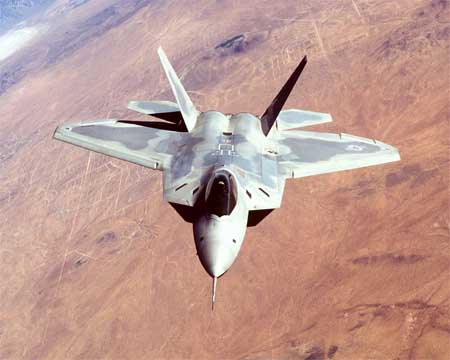
The F-22 program has provided the US with a spectacular dog-fighter, but we simply don’t currently live in an era that America has a direct competitor in this space.
The fighter is so head and shoulders above the competition that it has no competition.
The US finds itself fighting against enemies where the F-22 simply does not make sense as a reasonable expenditure.
However, there is value in the US maintaining its technological lead in military hardware. The US is so far ahead of other countries when it comes to conventional armies because of our constant investment.
I can only hope the day comes that this is no longer a valid concern as the world unites to fight larger foes. Climate change, starvation, and over-population of our planet are just the beginning of the issues we face.
Interest on U.S. Debt Cost
The total interest paid on US federal budget debt was $140.3 billion during the Apollo Program timeframe ($870.56 billion 2008 US dollars).
This means that interest paid on debt accounted for 655% more outlays than the Apollo Program cost in the same period.
For reference, the US paid $252.8 billion in 2008 in interest on the national debt—nearly twice the total cost of the entire Apollo program.
Taxpayers are funding horrendous amounts of interest on the debt of the current generation and its ancestors.
A single year of interest paid currently would pay for the entire original Apollo program.
It could cover the cost of a future Moon program and still have enough to produce most of the F-22 project.
While our country needs to get its debt wrangled, missing out on solid investments that pay dividends is foolhardy.
If we can pay out a few hundred billion dollars to reform health care and save the nation a few trillion dollars in the process—that’s an investment worth making (2020 note: consider the context this was written in 2008).
U.S. Interstate Highway System Cost & Benefit
The final cost for the Interstate Highway System to the Federal government started in 1956 by President Eisenhower was $114 billion by completion in 1991, about $500 billion in 2008 dollars.
That’s 376% the cost of the Apollo program.
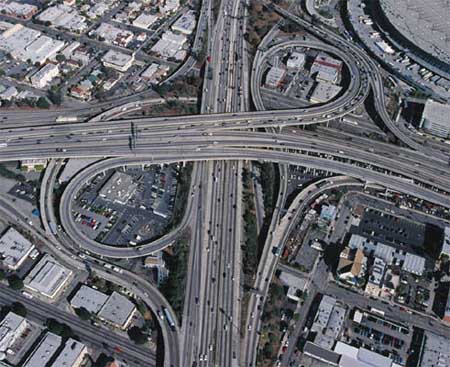
The Interstate Highway System has provided tens of thousands of government-sponsored jobs over the decades. It’s lead to much of the growth of the countries entire economic system.
Without this interstate highway system, how would our country have been able to move its goods to different regions for consumption and manufacturing?
The program is considered a necessity but another means of transportation was not weighed properly: railroads.
Prior to the Interstate Highway System, America revolved around the rails.
Rails were much more widely used to transport goods and people around the country. Subsidies to the highway system eventually lead to the somewhat sorry state of our current rail system.
Look to Europe for an example of a system still capable of using a modicum of transportation techniques across a fairly large distance. The highway system was vital to the culture and development of the US.
However, I believe that a slightly more balanced development of the highway system alongside the rail system could have lead to a strong, less car-dependent country.
Vietnam War Cost & Benefit
The cost of the Vietnam War from 1965-1975 was $111 billion or $686 billion in 2008 US dollars.
That’s 516% the cost of the Apollo program.
It’s a bit hard to describe the gains from the Vietnam War as we certainly lost many brave souls in the conflict.
The US was able to gain military experience which lead to a more thorough victory in Desert Storm.
During this period, the voting age was lowered to 18 from 21.
The military draft was eliminated.
An all-volunteer system was instated after the war.
U.S. Economic Stabilization (2008 Recession) Cost & Benefit
The Emergency Economic Stabilization Act of 2008 has authorized the Treasury Secretary to spend up to $700 billion taxpayer dollars.
There is hope taxpayers will come out of this bailout program without too deep of a loss.
A portion of the expenditures should result in profits to offset the expected losses. The true cost of the recent Federal bailouts of the financial sector are unknown.
If the program suffers a complete loss, it would represent 526% of the cost of the Apollo program.
The state of the economy was unclear for several years after the 2008-2009 Great Recession.
Would our nation have withstood the damage of the Great Recession without the Emergency Economic Stabilization Act of 2008?
The economic program cost taxpayers up to $700 billion.
It’s hard to say, we can’t rewind time, toss out the policy, and see what would have happened.
Economists generally agree that the Great Depression of the ’30s arose so strongly because of the hands-off approach of the governing body at the time.
With the country facing a dire recession, modern government has taken a much more hands-on approach. A variety of bailout-related acts were passed in an attempt to stabilize the country’s weakening economy.
Only time will tell how successful these programs have been.
Iraq and Afghanistan Wars Cost & Benefit
The war in Iraq and Afghanistan is estimated by the CBO to cost $2.4 trillion by 2017, $1.9 trillion attributed to Iraq.
Much of the cost of the war has been from deficit spending.

The Iraq and Afghanistan wars are still in progress (2020 note: STILL).
The entire notion of our country even entering these wars has thoroughly divided much of the US population, but I’ll attempt to stick to the facts.
The wars are estimated to cost the country some $2.4 trillion, nearly twenty times the Apollo Program cost.
The human cost in Iraq is estimated at over 100,000 lives, with over 30,000 being Americans.
There have been thousands of more casualties in Afghanistan.
Economically, we’ve gained greater access to natural resources in the region (oil).
We’ve prevented the growth of radical anti-Americanism in some specific regions but many would argue that the whole ordeal has also created a negative attitude towards the US.
Was the Apollo Program worth it?
The jobs created, the technology gains, the intangible feeling of love for the country, American ideals, the future of generations, and hope for spreading humankind through the galaxies are just some of which was inspired by and created from the Apollo Program missions.
I find it difficult to argue against the comparatively low Apollo Program cost, especially when looking at other significant expenditures taken on by the U.S.
Why are we so worried about attempting to push the envelope further with more space exploration?
Any future Moon landing project is just a stepping-stone for Mars and beyond.
The US is working with private industry to create efficient ways to send astronauts to space and beyond.
→ How Much Does It Cost to Go to Space? $6.25 Billion in 2020.
Do you really believe humankind will survive on Earth into perpetuity?
Part Two, this analysis continues in:
Space Exploration Benefits and Its Future (NASA to SpaceX).
Apollo Program Cost FAQ
The Apollo Program cost roughly $25.4 billion, unadjusted, in 1973. In 2020 dollars, that’s about $194 billion adjusted for inflation.
The total cost of the Apollo Program, including Apollo 11, was $25.4 billion, unadjusted.
NASA’s total budget appropriations for the Apollo Program through 1969 was $16.1 billion per official documents. The total cost of the Apollo Program up through about 1974 was $25.4 billion. Both amounts are unadjusted for inflation.
14 replies on “How Much Did the Apollo Program Cost (and Was It Worth It)?”
How “technically speaking” did the US manage to prevent the North Vietnamese into South Vietnam?
Sceptic,
Thanks for identifying the confusing phrasing. It was a poor attempt at relating the North/South conflict with Communist encroachment in the world, where the US delayed the North’s advance. I’ve removed the offending sentence from the article.
The US Waste Money All The Time But Some In Gov Have Benn Cutting Gov Funding For R&D & Other Public Woks Building &/Or Fixing Dams Bridges Roads Ect In Favor Of Turning More & More Over To The Private Sector. There’s Just Some Things That Shouldn’t Be Based On Profits. Privatizing Much Of The Military Is Partly Why The IRAQ WAR Cost So Much More Than The Vietnam War Which Was A Much Hotter WAR. The BUSH Administration Used The Private Sector & Contractors. Doing Jobs The Military Use To Do Cheaper With Better Outcomes. They Were Also Able To Skew The American Death Tolls By Not Including Contractors Ect.
So Should We Revise The Numbers From Vietnam & Other Past Wars Based On Their JOB & What They Were Doing When Killed In WAR???
Oh god.. Its been two years and no one has commented this atrocity misuse of grammar. My OCD is not going to take it anymore! Stop it, just, STOP IT 😉
There was a study done by the OMB or CBO in the 1970s (I think) that evaluated the returns to our economy from Project Apollo indicating that we received somewhere between four and seven dollars for every dollar spent in the form of new technologies, new scientific discoveries, new materials science, manufacturing and management paradigms for doing large projects, electronics, and medical imagining (CAT scans and NMRIs), etc.
I have heard of this study for many years, but can anyone provide a link to it? I would like to use it to refute those who say Project Apollo was a waste.
You may be thinking of this:
“A Midwest Research Institute (MRI) study of the relationship between R&D expenditures and technology-induced increases in GNP indicated that each dollar spent on R&D returns an average of slightly over seven dollars in GNP over an eighteen-year period following the expenditure (3). Assuming that NASA’s R&D expenditures produce the same economic payoff as the average R&D expenditure, MRI concluded that the $25 billion (1958) spent on civilian space R&D during the 1959-69 period returned $52 billion through 1970 and will continue to stimulate benefits through 1987, for a total gain of $181 billion.”
https://er.jsc.nasa.gov/seh/economics.html
There’s a bit more from the Freakonomics folks here, though no original source cited aside from the NASA person stating it:
“We explore space and create important new technologies to advance our economy. It is true that, for every dollar we spend on the space program, the U.S. economy receives about $8 of economic benefit. Space exploration can also serve as a stimulus for children to enter the fields of science and engineering.”
https://freakonomics.com/2008/01/11/is-space-exploration-worth-the-cost-a-freakonomics-quorum/
And where are these technologies and achievements, if now are forced to buy rocket engines from Russia and fly to the ISS in a Russian vehicle? The effectiveness of investments in the Apollo program is explained solely by the fact that in 1971 the dollar ceased to have gold content and its emission became virtually uncontrolled, from here is hence the “payback” of costs for Apollo. They inflated just a monetary bubble, included a mechanism of permanent inflation, which a burden on the economies of those countries that began to believe that the US is the most advanced country in all respects, with developed science, industry and technology. “Landing on the Moon” – it was necessary to prove the exclusivity of the United States in all aspects. There really was no landing, it was not needed. There was needed only the effect of the “landing”, and this effect was obtained by falsifying by Kubrick in the pavilion. But all this is not important, the main thing is money! Is not it?
Jerry Pournelle reported that during the same time as Apollo, the US spent as much on cosmetics, and New York among large states, spent more on liquor.
Robert Zubrin in late 90s reported that we spend more on each; fast food, illegal drugs, and lotteries, than on NASA. He showed that in terms of fraction of the total or discretionary budget, NASA is getting only fractionally less than during Apollo, while doing much less development of new capability. See his article “Two Roads for NASA”
Neill deGrasse Tyson pointed out that the TARP bailouts of ’08 were greater than the entire ~50 year running grand total NASA expenditure. Today, our DoD budget is about ~85% of that total. Not including black budget or ongoing operational costs in our continual war, each of which is more.
During our invasion of Iraq, we were spending ~$8 billion a month, about half the NASA annual budget.
Very good reading, and important insight.
I’ve been saying the same sorts of things for a while. I’ll use the 2 graphs, with attribution.
Great, thanks John and feel free to do so with attribution. I saw your post on Quora, cheers!
now figure out the missed opportunity cost on what might have gained if that money had been left with the private sector (ie not taxed in the first place) over the same time period.
competing with other government programs for value is hardly much of a competition, since government programs rarely if ever consider ROI as part of their justification, and so as a natural result almost always have a poor or even negative ROI (negative meaning we would have had better results if the government program hadn’t existed at all)
Because you can trust the parasites of private enterprise being honest, more efficient and cost effective, though this has never occurred on a single occasion. While rorting is common place and has cost billions. Just ask Ken Lay
is there a chart that shows what each state contributed to the apollo missions?
Donald, that’s a good question! I’m not aware of any such research.
I’m not fairly confident that most of that money wouldn’t have gone directly into executive bonuses or into risky, short-sighted investments.